
by Andrey Dimitrashuk at Lending Concepts
Conventional Loans in Folsom, CA
Welcome to your premier destination for securing conventional loans in Folsom, California. Navigating the real estate market requires a solid financial foundation, and a conventional mortgage is often the most powerful tool for homebuyers. Whether you are purchasing your first home, upgrading to a larger space for your growing family, or investing in Folsom real estate, Andrey Dimitrashuk and the team at Lending Concepts are here to guide you every step of the way.
With a commitment to transparent communication, competitive rates, and personalized financial strategies, we make the mortgage process seamless. Discover how a conventional loan can help you unlock the doors to your dream home in Folsom.

Conventional Loans in Folsom, CA
Flexible Home Financing for Buyers, Homeowners and Investors
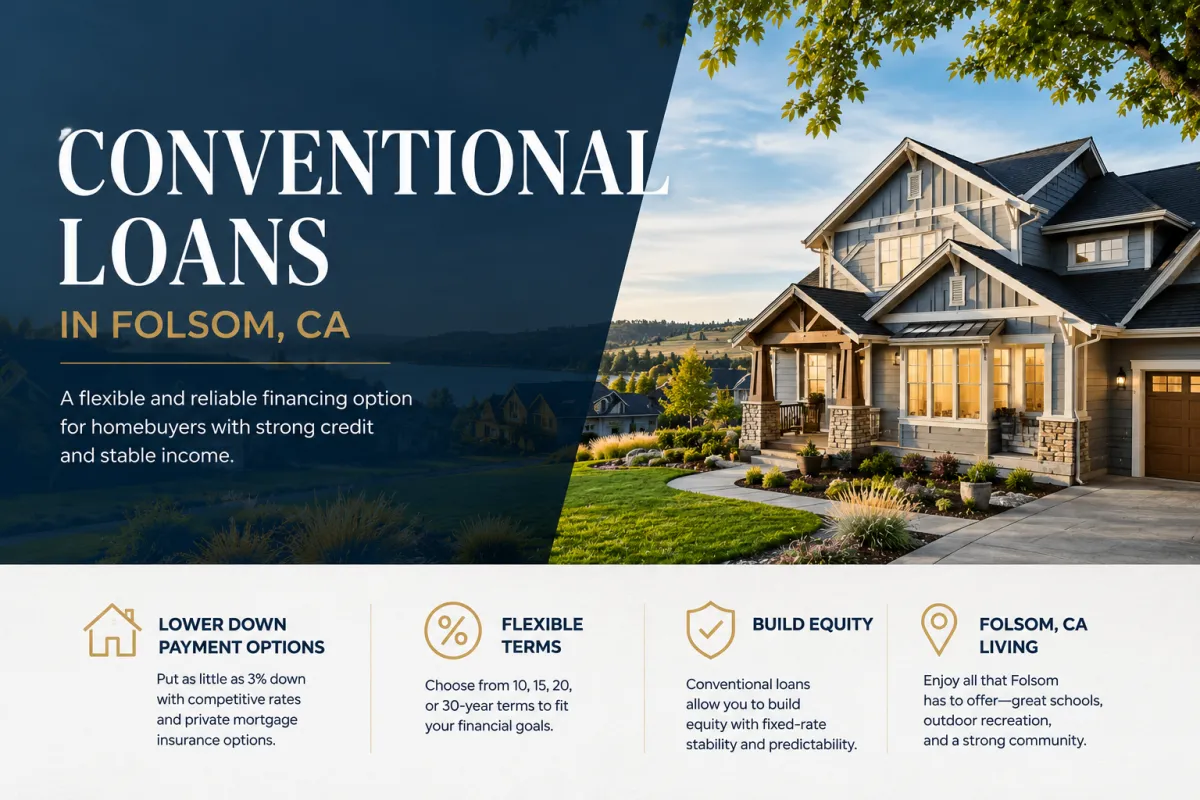
A conventional mortgage is one of the most widely used home financing options in California. It can be used to purchase or refinance a primary residence and, depending on the program, may also be available for second homes and investment properties.
Eligible borrowers may qualify for certain conventional loan programs with as little as 3% down, and private mortgage insurance may eventually be removed when applicable requirements are met.
If you are buying a home in Folsom, Sacramento, Roseville, Rocklin, Granite Bay, El Dorado Hills or elsewhere in California, I can help you compare conventional financing with FHA, VA, jumbo and other available mortgage options.
What Is a Conventional Loan?
A conventional loan is a mortgage that is not insured or guaranteed by a federal government agency such as the FHA, VA or USDA.
Many conventional mortgages are conforming loans, meaning they meet applicable requirements established for mortgages purchased by Fannie Mae or Freddie Mac.
Conventional loans may offer:
Low-down-payment options for eligible borrowers
Fixed-rate and adjustable-rate options
Financing for primary residences, second homes and investment properties
Private mortgage insurance that may eventually be removed
Competitive financing for qualified borrowers
2026 Conventional Loan Limits in Folsom and Sacramento County
Folsom is located in Sacramento County. The 2026 conforming loan limits are:
1-unit: $832,7502
2-unit: $1,066,2503
3-unit: $1,288,8004
4-unit: $1,601,750
If your required loan amount exceeds the applicable conforming limit, a Jumbo Mortgage may be worth considering.
How Much Down Payment Do You Need?
You do not necessarily need 20% down for a conventional mortgage.
Certain programs may allow eligible borrowers to purchase with:
As little as 3% down under qualifying programs
5% or more down in many conventional scenarios
Larger down payments when appropriate for the property or borrower
Putting 20% down can eliminate borrower-paid PMI in many cases, but it is not a universal requirement.
Eligibility depends on factors such as occupancy, property type, loan amount, income and underwriting findings.
What Credit Score Is Needed for a Conventional Loan?
There is not one universal credit-score requirement for every conventional mortgage.
Conventional underwriting evaluates the overall loan profile, including:
Credit history
Debt-to-income ratio
Down payment and loan-to-value
Income and employment
Assets and reserves
Property type and occupancy
Fannie Mae's Desktop Underwriter no longer applies a universal minimum third-party credit score to eligible DU casefiles. However, individual programs, lenders, mortgage insurers or manually underwritten loans may have separate requirements.
Credit can also affect mortgage pricing and PMI costs.
Conventional Loan Requirements
Typical conventional mortgage underwriting evaluates:
Income: Stable, qualifying income that is reasonably expected to continue.
Debt: Monthly obligations and debt-to-income ratio.
Assets: Funds for the down payment, closing costs and any required reserves.
Credit: Overall credit history and risk profile.
Property: Eligible property type, occupancy, appraisal and title.
Conventional financing may be available for single-family homes, condominiums, planned unit developments, certain manufactured homes and qualifying 2–4 unit properties.
What Is PMI on a Conventional Loan?
Private Mortgage Insurance (PMI) is commonly required when a conventional mortgage has a higher loan-to-value ratio, such as when the borrower puts less than 20% down.
PMI costs vary based on factors including credit, loan-to-value and loan amount.
Unlike some government mortgage insurance, borrower-paid PMI on many conventional loans may eventually be removed.
For qualifying mortgages, borrowers may generally request PMI cancellation when the principal balance is scheduled to reach 80% of the home's original value, subject to applicable requirements. Automatic termination generally occurs at 78% when applicable conditions are satisfied and the loan is current.
Can Conventional Loans Be Used for Second Homes or Investment Properties?
Yes. Depending on the program, conventional financing may be available for:
Primary residences
Second homes
One-unit investment properties
Certain 2–4 unit investment properties
Second-home and investment-property transactions generally have different down-payment, reserve, pricing and underwriting requirements.
Conventional Loans for Self-Employed Borrowers
Self-employed borrowers can qualify for conventional financing when their income and overall financial profile meet applicable requirements.
Underwriting may review tax returns, business income, profit-and-loss information and other documentation.
If traditional tax-return qualification does not accurately reflect your financial situation, it may also make sense to compare conventional financing with Bank Statement Loans, 1099 Income Loans or Asset Depletion Loans.
Conventional Mortgage Process
1. Review your financing goals
We review your income, credit, debts, assets, down payment and property goals.
2. Get pre-approved
Your financial information is evaluated to determine available loan options and purchasing capacity.
3. Find a home and make an offer
Once you have an accepted purchase agreement, the loan moves into processing.
4. Underwriting and appraisal
The lender reviews the borrower documentation, property, appraisal, title and other required items.
5. Closing
After final approval and completion of closing requirements, you sign the final loan documents.
Comparing Loan Options: Conventional vs. FHA
Many homebuyers in Folsom weigh the differences between Conventional and FHA loans. Below is a detailed comparison to help you understand why a conventional loan might be the superior choice for your situation.
| Feature | Conventional Loan | FHA Loan |
|---|---|---|
| Minimum Down Payment | 3% (for qualified first-time buyers) | 3.5% |
| Minimum Credit Score | Typically 620 | 580 (for 3.5% down) |
| Mortgage Insurance | PMI required if down payment is under 20%. Can be cancelled later. | Upfront premium required. Annual premium required for the life of the loan (if putting down less than 10%). |
| Property Types allowed | Primary, Second Home, Investment Property | Primary Residence only |
| Appraisal Standards | Standard property condition requirements | Stricter health and safety property requirements |
Note: Loan terms and conditions are subject to change based on market conditions and individual borrower qualifications. Contact Andrey Dimitrashuk for a personalized quote.
Why Work With Andrey Dimitrashuk?
I review the complete mortgage scenario—not just one credit score or income number—to help determine which available financing structure may fit your goals.
Depending on your situation, that may include:
Conventional mortgages
FHA or VA loans
Jumbo mortgages
Bank Statement Loans
1099 Income Loans
Asset Depletion Loans
See What My Clients Say
Conventional Mortage FAQs
What is a conventional mortgage?
A conventional mortgage is a home loan that is not insured or guaranteed by a federal government agency. Many conventional loans meet Fannie Mae or Freddie Mac conforming guidelines.
What is the conventional loan limit in Folsom for 2026?
What is the conventional loan limit in Folsom for 2026?
Folsom is in Sacramento County. The 2026 conforming loan limit for a one-unit property is $832,750. Higher limits apply to qualifying 2–4 unit properties.
Can I get a conventional mortgage with 3% down?
Certain conventional programs allow eligible borrowers to purchase with as little as 3% down. Eligibility depends on the borrower, occupancy, property and program.
Do I need a 620 credit score for a conventional loan?
Not in every case. There is no universal 620 minimum that applies to every conventional mortgage scenario. Credit requirements depend on the underwriting method, program and overall borrower profile.
Do I need 20% down?
No. Eligible borrowers may qualify with substantially less than 20% down. PMI may apply when the loan-to-value is higher.
Can gift funds be used?
Eligible gift funds may be permitted for many conventional transactions, subject to documentation and program requirements.
Can I buy an investment property with a conventional loan?
Yes. Conventional financing may be available for eligible investment properties, although down-payment, reserve and underwriting requirements differ from primary-residence financing.
Is a conventional loan better than FHA?
It depends. Conventional financing may offer advantages for some borrowers, while FHA may be a better fit for others. Comparing both using your actual financial profile is the best way to determine the appropriate option.
Find Out Whether a Conventional Loan Fits Your Plans
Whether you're buying your first home, moving, refinancing, purchasing a second home or investing in real estate, conventional financing may provide a flexible option.
I can review your scenario and compare conventional financing with other available mortgage programs.
Andrey Dimitrashuk
Mortgage Loan Originator
Folsom Office
785 Orchard Dr #250
Folsom, CA 95630
Hours: Open 24 hours (by appointment after normal business hours)
Languages: English · Russian · Ukrainian
Языки: Английский · Русский · Украинский
Мови: Англійська · Російська · Українська


Rocket Mortgage is an Equal Housing Lender. As prohibited by federal law, we do not engage in business practices that discriminate on the basis of race, color, religion, national origin, sex, marital status, age (provided you have the capacity to enter into a binding contract), because all or part of your income may be derived from any public assistance program, or because you have, in good faith, exercised any right under the Consumer Credit Protection Act. The federal agency that administers our compliance with these federal laws is the Federal Trade Commission, Equal Credit Opportunity, Washington, DC, 20580.
California: Licensed by the Department of Financial Protection and Innovation under the California Residential Mortgage Lending Act
© 2026 Loans by Drey, a DBA of Andrey Dimitrashuk operating under Rocket Mortgage. All rights reserved.
Last updated: October 6, 2026