
Mortgage Refinance in Folsom, California
Review Your Rate, Payment, Loan Term or Home Equity Options
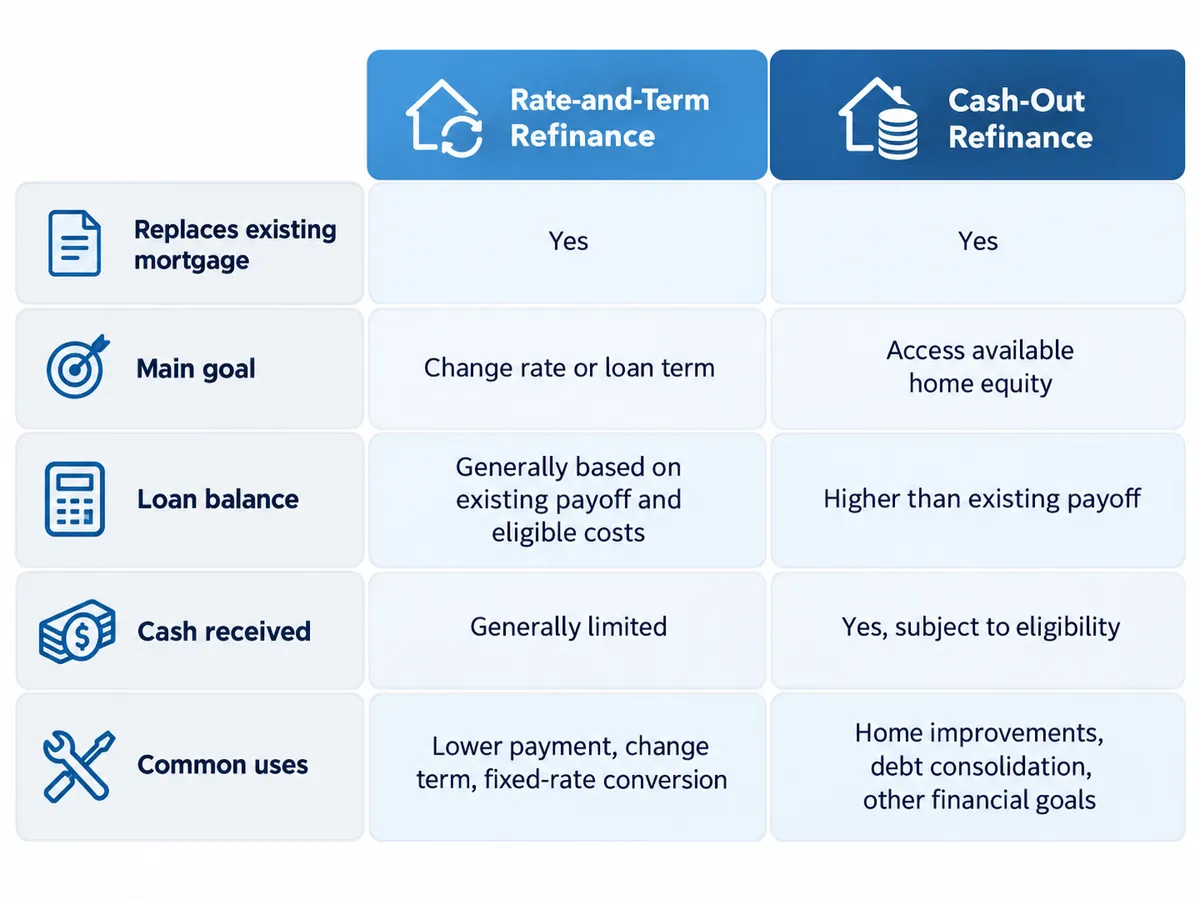
A mortgage refinance replaces your existing home loan with a new mortgage.
Depending on your situation, refinancing may help you:
Reduce your interest rate or monthly principal-and-interest payment
Shorten or change your loan term
Switch from an adjustable-rate mortgage to a fixed-rate loan
Remove mortgage insurance when eligible
Access available home equity with a cash-out refinance
Change borrowers on the mortgage when permitted
If you own a home in Folsom, Sacramento, Roseville, Rocklin, Granite Bay, El Dorado Hills or elsewhere in California, I can help you compare your existing mortgage with current refinance options.
Andrey Dimitrashuk | Mortgage Loan Originator | NMLS #1583893
When Does Refinancing a Mortgage Make Sense?
A refinance may be worth reviewing when you want to:
Lower Your Interest Rate or Payment
If current financing provides better terms than your existing mortgage, refinancing may reduce your monthly principal-and-interest payment or long-term interest expense.
Pay Off Your Mortgage Faster
Moving from a longer loan term to a shorter term may reduce the amount of interest paid over time, although the monthly payment may increase.
Switch From an ARM to a Fixed Rate
Homeowners with an adjustable-rate mortgage may refinance into a fixed-rate loan for more predictable principal-and-interest payments.
Remove PMI
If your property value has increased or your loan balance has declined, refinancing may provide a way to eliminate private mortgage insurance when the new loan meets applicable requirements.
Access Home Equity
A cash-out refinance may allow eligible homeowners to replace their existing mortgage with a larger loan and receive part of the difference in cash.
Rate-and-Term Refinance vs. Cash-Out Refinance
How Much Does It Cost to Refinance?
Refinancing has closing costs just like a home purchase.
Costs may include:
Loan origination or lender charges
Appraisal when required
Title and settlement services
Credit report
Recording fees
Prepaid interest
Escrow-related items when applicable
Refinance closing costs often fall in the range of 3%–6% of the loan amount, although your actual costs depend on the loan, property and transaction.
Some refinance structures may allow certain costs to be financed into the new mortgage or offset through pricing, but that can increase the loan balance, interest rate or long-term cost.
What Is the Refinance Break-Even Point?
The break-even point estimates how long it takes for your monthly savings to recover the cost of refinancing.
A simple formula is:
Closing Costs ÷ Monthly Savings = Break-Even Period
Example
Assume your refinance costs are $6,000 and the new mortgage reduces your monthly principal-and-interest payment by $250.
$6,000 ÷ $250 = 24 months
In this example, it would take approximately two years for the monthly savings to recover the refinance costs.
If you expect to sell the home or refinance again before reaching the break-even point, the transaction may be less attractive.
Cash-Out Refinance
A cash-out refinance replaces your current mortgage with a larger loan and allows you to receive part of your available home equity in cash.
Homeowners may consider cash-out refinancing for:
Home improvements
Major repairs
Debt consolidation
Education expenses
Investment or business-related goals
Other significant financial needs
Cash-out refinancing reduces the amount of equity you retain in the home and increases your mortgage balance.
It should be compared with alternatives such as a Home Equity Loan or HELOC, especially if your existing first-mortgage rate is attractive.
Refinance Requirements
Qualification varies by loan program, but lenders generally review:
Credit: Your credit history and overall risk profile.
Income: Sufficient qualifying income to support the new mortgage.
Debt-to-income ratio: Your monthly obligations compared with qualifying income.
Home equity: The relationship between the new loan amount and property value.
Property: Eligible property type, occupancy, appraisal and title.
Payment history: Your recent mortgage payment history may also affect available refinance programs.
FHA and VA Refinance Options
Homeowners with existing government-backed mortgages may have additional refinance options.
FHA Refinance
Eligible FHA borrowers may be able to use an FHA refinance, including certain FHA Streamline Refinance options.
Streamline programs may require less documentation than a standard refinance, but eligibility, seasoning and borrower-benefit requirements apply.
VA IRRRL
Eligible homeowners with an existing VA loan may qualify for a VA Interest Rate Reduction Refinance Loan (IRRRL).
A VA IRRRL is designed to refinance an existing VA-backed mortgage and generally must provide a qualifying borrower benefit.
Should You Refinance Into a New 30-Year Mortgage?
A lower payment does not always mean a refinance saves money.
For example, if you are several years into a 30-year mortgage and refinance into another new 30-year loan, you may extend the amount of time you are paying interest.
That can lower the monthly payment while potentially increasing the total interest paid over the life of the loan.
I recommend comparing:
New monthly payment
Closing costs
Break-even point
New loan term
Remaining term on your current mortgage
Total projected interest
before deciding.
Mortgage Refinance Process
1. Review your existing mortgage
We look at your current rate, balance, payment, remaining term and refinance goals.
2. Compare refinance options
We evaluate available loan structures based on your credit, income, equity and property.
3. Apply and provide documentation
Income, assets, insurance, mortgage information and other documents may be required.
4. Appraisal and underwriting
An appraisal may be required depending on the program and transaction.
5. Closing
After final approval, you review the Closing Disclosure and complete the new mortgage closing.
Your existing mortgage is then paid off through the refinance transaction.
Why Work Whith Andrey Dimitrashuk?
A refinance decision should be based on more than a new interest rate.
I can help you compare your existing mortgage with available options and review the potential effect on:
Monthly payment
Interest expense
Loan term
Closing costs
Break-even period
Home equity
Depending on your situation, available options may include conventional, FHA, VA, jumbo, cash-out and alternative-documentation refinance programs.
See What My Clients Say
Mortgage Refinance FAQs
Is refinancing worth it if my rate is only slightly lower?
Possibly. There is no universal rate reduction that automatically makes refinancing worthwhile. Compare the closing costs, monthly savings, break-even period, new loan term and total interest expense.
How much does it cost to refinance a mortgage?
Refinance closing costs commonly range around 3%–6% of the loan amount, although actual costs vary by transaction.
How much equity do I need to refinance?
Equity requirements depend on the refinance type, property, occupancy, credit profile and loan program. Cash-out refinances generally require more remaining equity than rate-and-term refinances.
Can I refinance and take cash out?
Eligible homeowners may be able to use a cash-out refinance to replace the existing mortgage with a larger loan and receive part of the available equity in cash.
Can I refinance if I am self-employed?
Yes. Self-employed borrowers may qualify for traditional refinance programs or, when appropriate, alternative-documentation options such as Bank Statement, 1099 Income or other available programs.
Can refinancing remove PMI?
Potentially. If the new conventional mortgage meets applicable loan-to-value and other requirements, refinancing may eliminate existing private mortgage insurance.
Do I need an appraisal to refinance?
Not always. Whether an appraisal is required depends on the loan program, property and underwriting findings.
Does refinancing hurt my credit?
Applying for a refinance generally involves a hard credit inquiry and opening a new mortgage account, which can affect your credit profile. The impact varies by borrower.
Find Out Whether Refinancing Makes Sense for You
A mortgage refinance should improve your financial position or help accomplish a specific goal—not simply replace one mortgage with another.
I can review your current loan and compare the payment, costs, break-even period, loan term and available equity before you decide.
Andrey Dimitrashuk
Mortgage Loan Originator
Folsom Office
785 Orchard Dr #250
Folsom, CA 95630
Hours: Open 24 hours (by appointment after normal business hours)
Languages: English · Russian · Ukrainian
Языки: Английский · Русский · Украинский
Мови: Англійська · Російська · Українська


Rocket Mortgage is an Equal Housing Lender. As prohibited by federal law, we do not engage in business practices that discriminate on the basis of race, color, religion, national origin, sex, marital status, age (provided you have the capacity to enter into a binding contract), because all or part of your income may be derived from any public assistance program, or because you have, in good faith, exercised any right under the Consumer Credit Protection Act. The federal agency that administers our compliance with these federal laws is the Federal Trade Commission, Equal Credit Opportunity, Washington, DC, 20580.
California: Licensed by the Department of Financial Protection and Innovation under the California Residential Mortgage Lending Act
© 2026 Loans by Drey, a DBA of Andrey Dimitrashuk operating under Rocket Mortgage. All rights reserved.
Last updated: October 6, 2026