
1099 Income Mortgage Loans in California
Qualify for a Mortgage Using Your 1099 Income
If you are an independent contractor, freelancer, consultant, real estate professional, gig worker, or other self-employed borrower who receives Form 1099 income, qualifying for a mortgage can look very different from qualifying as a traditional W-2 employee.
A 1099 income mortgage may provide another way to document your earnings when traditional tax-return qualification does not accurately reflect your financial situation.
Depending on the mortgage program, eligible borrowers may be able to use documented 1099 income as an alternative method of verifying earnings rather than relying exclusively on traditional W-2 income or taxable net income.
Can you get a mortgage with 1099 income?
Yes.
Independent contractors, freelancers, and other self-employed borrowers may qualify for a mortgage using documented 1099 income. Depending on the loan program, income may be verified through traditional tax returns or through eligible alternative documentation such as 1099 forms and supporting financial records.
What Is a 1099 Income Mortgage Loan?
“1099 mortgage loan” is a commonly used term rather than one standardized mortgage program; qualification methods and documentation requirements vary by lender and loan program.
A 1099 income loan is a mortgage qualification method designed for borrowers who receive income as independent contractors rather than traditional W-2 employees.
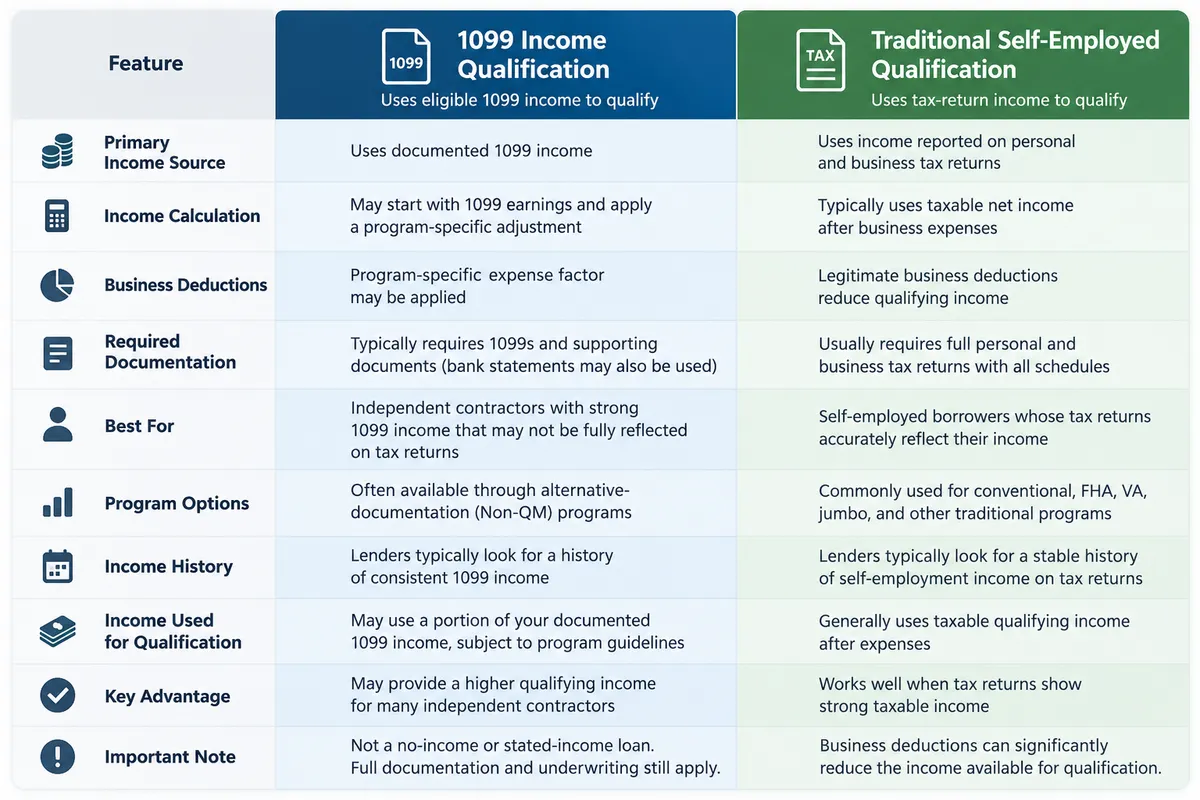
Traditional self-employed mortgage underwriting often evaluates income using personal and business tax returns. Legitimate business deductions can reduce taxable income, which may also reduce the amount of income available for mortgage qualification.
Certain alternative-documentation mortgage programs may evaluate income using Form 1099-NEC, other eligible 1099 forms, and supporting financial documentation.
A 1099 loan is not a no-income-verification mortgage. The lender still evaluates your documented income, credit, debts, assets, property, and overall ability to repay the loan.
Who May Benefit From a 1099 Income Loan?
A 1099 mortgage may be worth exploring if you earn most or all of your income as an:
Independent contractor
Freelancer
Consultant
Real estate agent
Insurance professional
Commission-based independent professional
Rideshare or delivery contractor
Healthcare contractor or traveling professional
Technology or creative contractor
Other self-employed professional receiving Form 1099 income
A 1099 loan may be particularly useful when your documented contract income is strong but business deductions on your tax returns reduce the income available under traditional mortgage guidelines.
How Is 1099 Income Used to Qualify?
The exact calculation varies by lender and mortgage program, but the process generally starts with the income documented on eligible 1099 forms.
The lender may:
Review your recent 1099 income.
Verify the history and stability of your earnings.
Apply any required expense factor or program-specific adjustment.
Determine your eligible monthly qualifying income.
Compare that income with your monthly debts and proposed housing payment.
Review your credit, assets, reserves, property, and overall financial profile.
The resulting qualifying income depends on the specific loan program.
This is important because $150,000 of annual 1099 income does not necessarily mean that the lender will use the full $150,000 for mortgage qualification.
Simple Example
Assume an independent contractor receives $150,000 in eligible 1099 income during the applicable qualifying period.
Rather than automatically qualifying the borrower using either the full $150,000 or the taxable income shown on a tax return, the lender applies the calculation required by the specific mortgage program.
If the program requires an expense adjustment, the lender would apply that adjustment before determining the monthly income available for mortgage qualification.
The final qualifying income depends on the program, type of work, income history, documentation, and overall borrower profile.
1099 Income vs. Traditional Self-Employed Qualification
What Documents May Be Required?
Documentation requirements vary, but a 1099 income mortgage may require items such as:
Recent Form 1099-NEC or other applicable 1099 forms.
Evidence of current year-to-date income
Documentation showing the source and continuity of 1099 earnings
Verification of self-employment or independent-contractor activity
Personal bank statements
Documentation of assets and reserves
Identification and standard mortgage application documents
Additional documentation requested by underwriting
A 1099 loan should not be confused with a stated-income or no-documentation mortgage.
Mortgage lenders still must evaluate whether the borrower has the financial ability to repay the loan.
Typical 1099 Mortgage Loan Requirements
Documented and reasonably stable 1099 income
Acceptable credit profile
Sufficient income relative to monthly debts
Required down payment or available equity
Assets and reserves as required by the program
Eligible property type and occupancy
Supporting documentation required by underwriting
1099 Loan vs. Bank Statement Loan
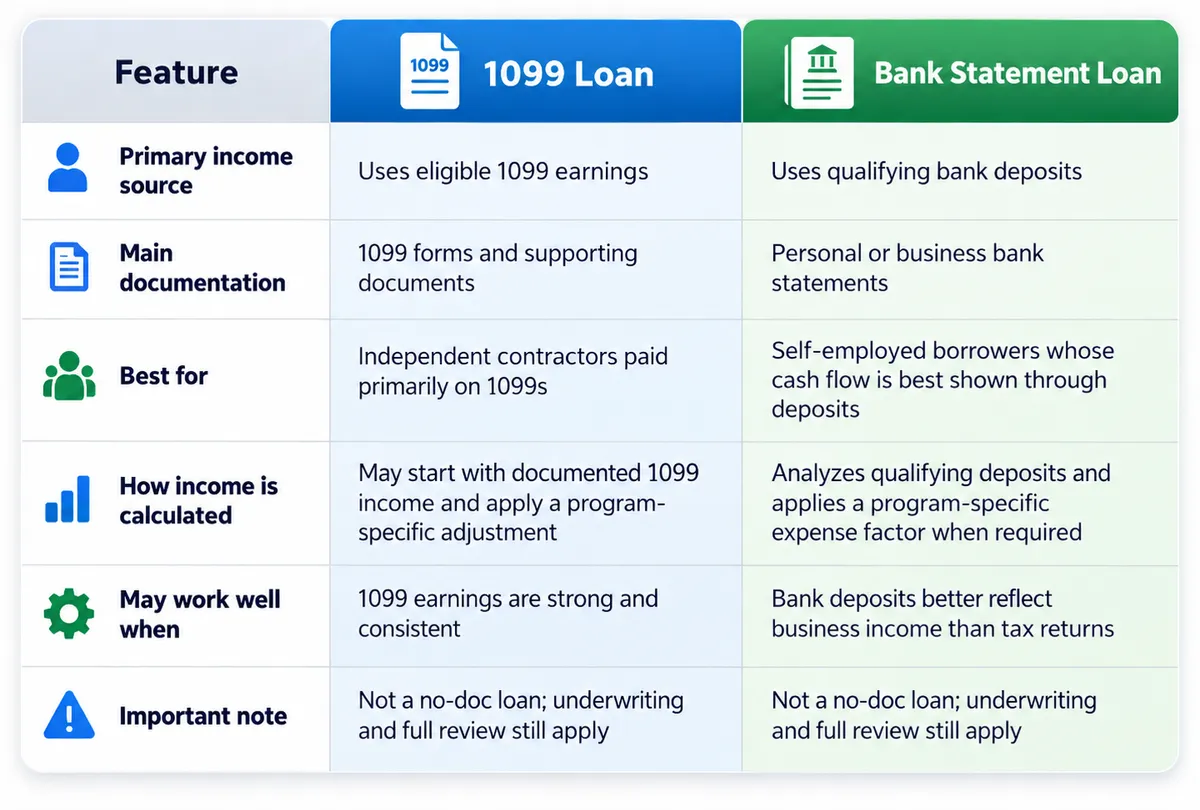
Neither option is automatically better.
If your 1099 income is strong and consistent, a 1099 program may make sense. If your bank deposits provide a stronger picture of your business cash flow, a Bank Statement Loan may be worth considering instead.
Can You Get a Mortgage With 1099 Income?
Yes.
Receiving 1099 income does not automatically prevent you from obtaining a conventional mortgage.
Traditional mortgage programs may use self-employment income when the borrower meets the applicable history, documentation, stability, and income requirements.
However, traditional underwriting generally relies on taxable qualifying income rather than simply using the gross amount shown on a 1099.
If substantial legitimate business deductions reduce the income shown on your tax returns, an alternative-documentation program may provide another option.
The best strategy is to compare both methods before deciding which loan structure to use.
Why Work With Andrey Dimitrashuk for a 1099 Mortgage?
Mortgage qualification for independent contractors is rarely as simple as looking at one number on a 1099.
The right approach depends on how you earn your income, how long you have earned it, how your tax returns look, your business expenses, credit, assets, down payment, property, and financing goals.
I can review your complete financial picture and compare available qualification methods, including:
1099 income qualification, Bank Statement Loans, conventional financing, jumbo mortgages, Asset Depletion, and other available alternative-documentation programs.
The objective is not to force your situation into one mortgage product.
It is to determine which available method gives you the strongest and most appropriate path to qualification.
See What My Clients Say
1099 Income Mortgage FAQs
What is a 1099 mortgage loan?
A 1099 mortgage loan is a mortgage qualification option that may allow eligible independent contractors and self-employed borrowers to document income using Form 1099 earnings rather than relying exclusively on traditional W-2 income or full tax-return qualification.
Are 1099 mortgage loans Non-QM?
Many alternative-documentation 1099 mortgage programs are Non-QM loans. However, receiving 1099 income does not automatically require a Non-QM mortgage. Eligible self-employed borrowers may also qualify for conventional, FHA, VA, jumbo, or other traditional financing using standard income documentation.
Do I need tax returns for a 1099 income loan?
It depends on the mortgage program. Certain alternative-documentation programs may calculate qualifying income using 1099 forms and other supporting documents rather than traditional tax-return income. Additional documentation may still be required by underwriting.
Does a lender use gross 1099 income?
The calculation varies by program. Certain 1099 mortgage programs may begin with the income documented on eligible 1099 forms and then apply an expense factor or other program-specific adjustment before determining qualifying monthly income.
How many years of 1099 income do I need?
Income-history requirements vary by loan program. Lenders generally want to establish that the income is stable, documented, and reasonably expected to continue. Your complete employment and income history should be reviewed before determining which program is available.
What is the difference between a 1099 loan and a bank statement loan?
A 1099 loan generally uses eligible 1099 earnings as the primary income documentation. A bank statement loan generally analyzes qualifying deposits shown on personal or business bank statements. The better option depends on which method most accurately demonstrates your qualifying income.
Can I use a 1099 mortgage to buy or refinance a home?
Depending on the available program, 1099 income qualification may be available for home purchases and certain refinance transactions. Property type, occupancy, credit, equity, and other program requirements apply.
How much down payment is required for a 1099 loan?
There is no single down-payment requirement for every 1099 mortgage. The required down payment or equity depends on the specific program, credit profile, loan amount, property type, occupancy, and other underwriting factors.
What credit score do I need for a 1099 mortgage loan?
Credit score requirements vary by lender and mortgage program. The required score may also depend on the loan amount, down payment or equity, property type, reserves, and overall borrower profile.
Are 1099 mortgage rates higher than conventional mortgage rates?
Alternative-documentation and Non-QM mortgages may have different pricing than comparable conventional financing. Actual rates depend on the loan program, credit profile, down payment, loan amount, property, and current market conditions.
Find Out Whether a 1099 Income Loan Could Work for You
If you earn your income as an independent contractor, freelancer, consultant, real estate professional, gig worker, or other 1099 earner, your mortgage qualification should reflect the way you actually earn money.
I can review your income and compare 1099 qualification, asset depletion, conventional financing, a jumbo mortgage, a bank statement loan, or another qualification method to determine which approach may fit your situation.
Andrey Dimitrashuk
Mortgage Loan Originator
Folsom Office
785 Orchard Dr #250
Folsom, CA 95630
Hours: Open 24 hours (by appointment after normal business hours)
Languages: English · Russian · Ukrainian
Языки: Английский · Русский · Украинский
Мови: Англійська · Російська · Українська


Rocket Mortgage is an Equal Housing Lender. As prohibited by federal law, we do not engage in business practices that discriminate on the basis of race, color, religion, national origin, sex, marital status, age (provided you have the capacity to enter into a binding contract), because all or part of your income may be derived from any public assistance program, or because you have, in good faith, exercised any right under the Consumer Credit Protection Act. The federal agency that administers our compliance with these federal laws is the Federal Trade Commission, Equal Credit Opportunity, Washington, DC, 20580.
California: Licensed by the Department of Financial Protection and Innovation under the California Residential Mortgage Lending Act
© 2026 Loans by Drey, a DBA of Andrey Dimitrashuk operating under Rocket Mortgage. All rights reserved.
Last updated: October 6, 2026